For editors and journalists
Amplianism in three minutes
Everything you may want to check before publishing: the idea, the data with a link to every source, the book, the author, and the pieces he can write for you.
The idea
Amplianism starts from one question that applies to a home, a company or a country: when something goes wrong, who pays?
- First law: whoever pays decides who speaks. If reporting an error costs the person who reports it, no one reports. The error disappears from the record, not from reality.
- Second law: whoever pays decides who tries. If failing costs everything, only those who already have enough try again. Everyone else stays still.
- The rule: whoever decides pays first. Nobody above error, nobody below a fresh start.
Being hard on those who decide and light on those who are learning is not kindness. It is intelligence.
What is new: left and right argue about how much the state should do. Amplianism asks an earlier question, where the cost of error lands, and bets that it explains who prospers better than either label.
The data, with sources
- Tips uncover 43% of occupational fraud; external audits uncover 2%. In Latin America, 54% versus 0%. Source: ACFE, Occupational Fraud 2026: A Report to the Nations.
- 82% of whistleblowers who used their own name were fired, quit under pressure or lost responsibilities. Source: Dyck, Morse and Zingales, Journal of Finance, 2010.
- A Michigan hospital system began disclosing errors to patients and offering compensation: lawsuits fell by about 65%. Source: Kachalia et al., Annals of Internal Medicine, 2010.
- In 47 of 48 countries, people who have closed a business want to start again more than people who never did. Source: Global Entrepreneurship Monitor.
- Half of Brazil's adults are registered as defaulters (49.9% in February 2026). Source: Serasa Experian.
- In Brazil, a bankrupt company can have its obligations extinguished in 3 years (Law 11,101, art. 158, V); an individual can only renegotiate (Consumer Code, art. 104-B). Source: Brazilian Law 11,101/2005 and Consumer Defense Code.
- The European Union guarantees entrepreneurs a discharge of debt within 3 years. Source: Directive (EU) 2019/1023.
- After 2008, Iceland convicted 36 bankers; in the United States, one bank executive went to prison over the crisis. Source: Irish Times; University of Chicago Law Review.
- France let people keep unemployment benefits while starting a company: about 25% more firms, with no drop in quality. Source: Hombert, Schoar, Sraer and Thesmar (HEC Paris).
Pieces the author can write for you
- The Cheapest Fraud Detector Is the Employee We Fire
- People Don't Stay Silent at Work Because They're Cowards
- The Political Question Nobody on Left or Right Is Asking
- Capitalism Works When Whoever Decides Pays First
- Silicon Valley's Real Edge Is a Cheap Second Try
- Latin America Gave the Fresh Start to Companies, Not to People
Every piece is original and exclusive to one outlet. Length, timing and angle are set by the editor.
The book
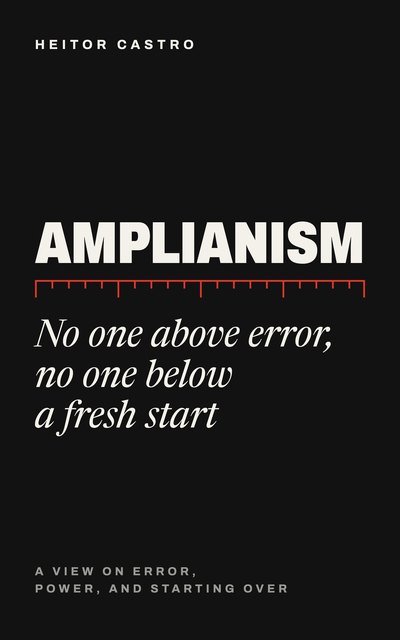
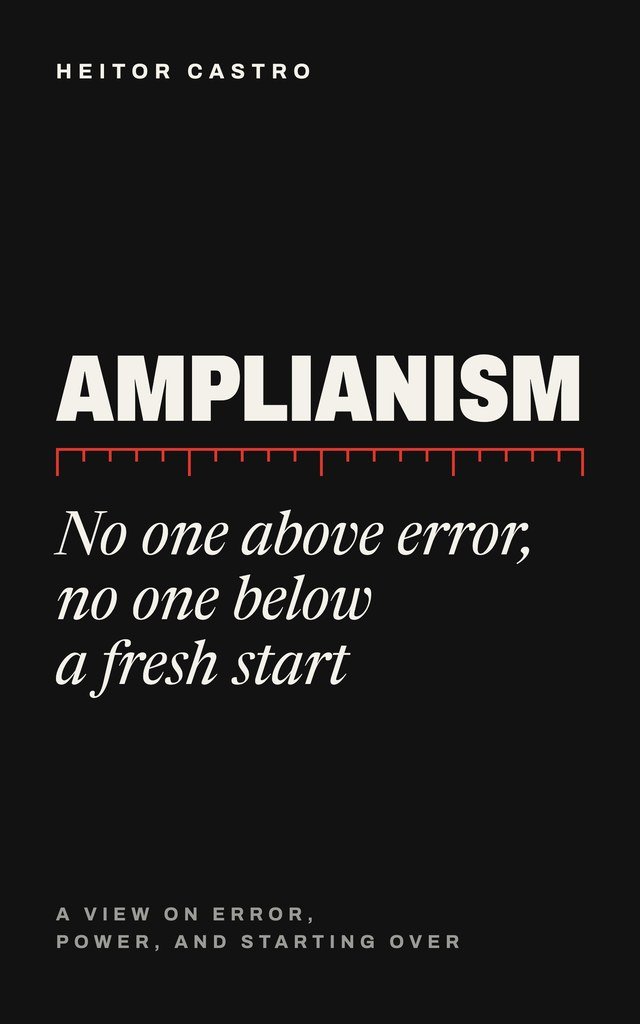
Amplianism: The Economics of Error. Who Can Warn, Who Can Try, and Who Should Pay First. October 2026, about 190 pages and more than 300 source notes, in four languages.
Download the high-resolution cover
Editions:
- Português: Impresso / Paperback
- English: Kindle · Paperback
- Español: Kindle · Tapa blanda
- Français: Kindle · Broché
The author

Heitor Castro is an investor and entrepreneur based in São Paulo, Brazil. He has spent his career building and running companies in Brazil, and wrote the book from what he saw up close: who pays when something goes wrong.
Interviews, talks and contact
Available for interviews in English or Portuguese, video calls, and 45 to 60 minute talks for teams and events.
Email: heitor@grupohc.co
WhatsApp: +55 11 98840-1944