A view on error, power, and starting over
Amplianism
Widen who can fail, tell, and try again.
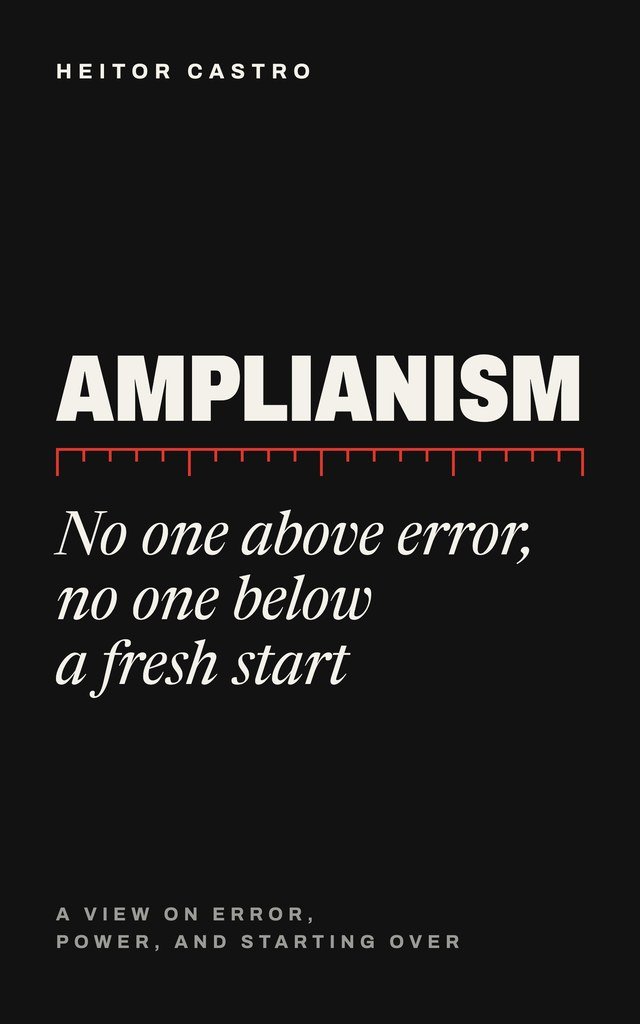
No one above error, no one below a fresh start.
Choose how to read
Get to know the economics of error
Get to know the economics of error
If telling the error costs too much, no one tells. If failing costs everything, no one tries. And almost everywhere, the people who pay that bill are the ones who did not decide. Amplianism (Amplianismo in Portuguese) shows why places go blind and stand still, and what changes when the bill goes to the right place.
Learn more
The philosophy
What Amplianism explains
- am·pli·a·nism noun
- 1 A philosophy that understands any place, from a home to a country, through one question: when something goes wrong, who pays? Where the bill always falls on those who did not decide, no one tells the error and no one tries again.
- 2 From amplitude: how many people can fail, tell, and try again without being ruined. The greater a place's amplitude, the better it is.
The theory in two sentences
If telling costs too much, no one tells
The people who do the work see the error first. If they are the ones who will pay, they keep quiet. The error grows in the dark until everything implodes. At Theranos, the people who spoke up were watched by private investigators. At Nvidia, telling the customer about the error saved the company.
If failing costs everything, no one tries
Where the first stumble ruins you, only those who already have something try again. In Brazil, a bankrupt company can have its debts wiped out in three years; an ordinary person does not get that deadline. Where failing is cheap, Amazon loses $170 million on a phone, keeps the person who tried, and months later launches Alexa.
Being hard on those who decide and easy on those who are learning is not kindness. It is intelligence.
The method
One question, two laws, and one rule. They work for everything.
- 01The question: when something goes wrong, who pays?
- 02Whoever pays decides who speaks. If telling costs too much, no one tells.
- 03Whoever pays decides who tries. If failing costs everything, no one tries.
- 04The rule: no one above error, no one below a fresh start. Whoever decides pays first; whoever does the work can tell and try again without being ruined.
To understand it
See it in action

The author
Heitor Castro
Heitor Castro is a Brazilian entrepreneur and investor with more than a decade of experience, active in more than ten industries, with investments in Silicon Valley, California. His career spans building, managing, and investing in businesses across different markets.
The essence of this philosophy
"I grew up watching my grandfather work at his grocery store. He was tough with almost everyone; with me, since I was learning, he was patient. It took me years to understand: people who are learning need to fail cheaply. Later, auditing airports and taking flying lessons, I saw the opposite of the rest of the world: in aviation, whoever sees the error reports it, because reporting is protected. I started my first company at 23, and today I am the one who decides. I have been on both sides of the bill.
Reading history and writing about the great names in business, I saw the pattern: what brings down a company is almost never the error. It is the price of telling the error."